Field notes
Does Your MCP Server Need to Migrate Before July 28?
The MCP 2026-07-28 spec is the protocol's largest revision since launch, but backward compatibility means most servers don't have to migrate on day one. Here's how to tell which camp you're in.
Mark
Head of Marketing, MCPOrbit
- Published
- Updated
- · Updated
- Read time
- · 5 min read
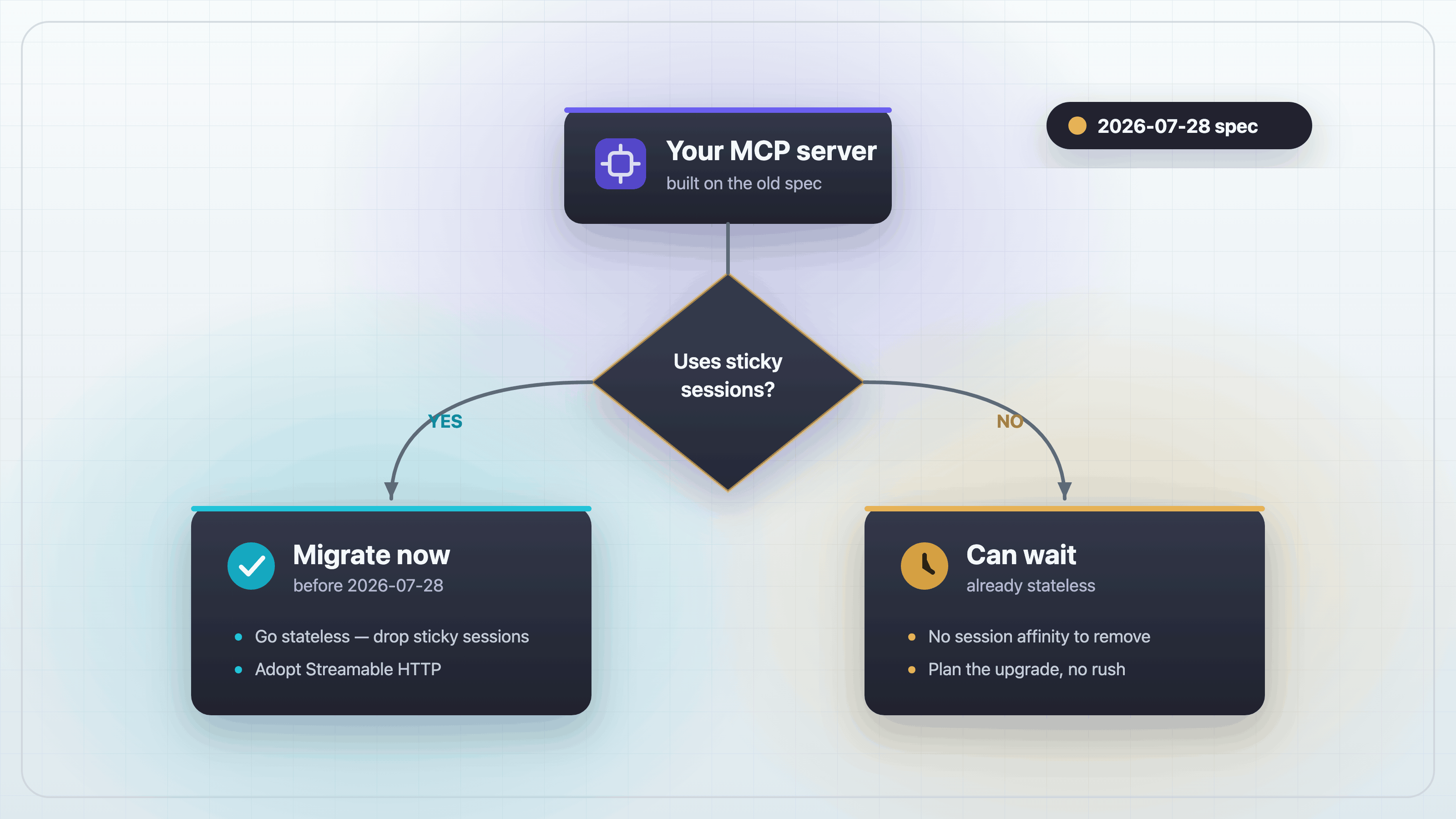
Short answer: almost certainly not on July 28 itself. The MCP 2026-07-28 specification removes the initialize/initialized handshake (SEP-2575) and the Mcp-Session-Id session header (SEP-2567), but v2 servers keep answering the legacy 2025-11-25 handshake, so existing clients keep connecting. The servers that must act first are remote HTTP servers that depend on sticky sessions or a shared session store.
This is the largest revision of the Model Context Protocol (MCP) since launch. The spec went final on 2026-07-28, and stable v2 has since shipped: @modelcontextprotocol/server and @modelcontextprotocol/client are at 2.1.0 on npm, and mcp is at 2.2.0 on PyPI (checked 2026-09-24). That deadline created urgency that, in most cases, wasn't warranted. Whether you need to move still depends on one question: does your server depend on session affinity?
What actually changes on 2026-07-28
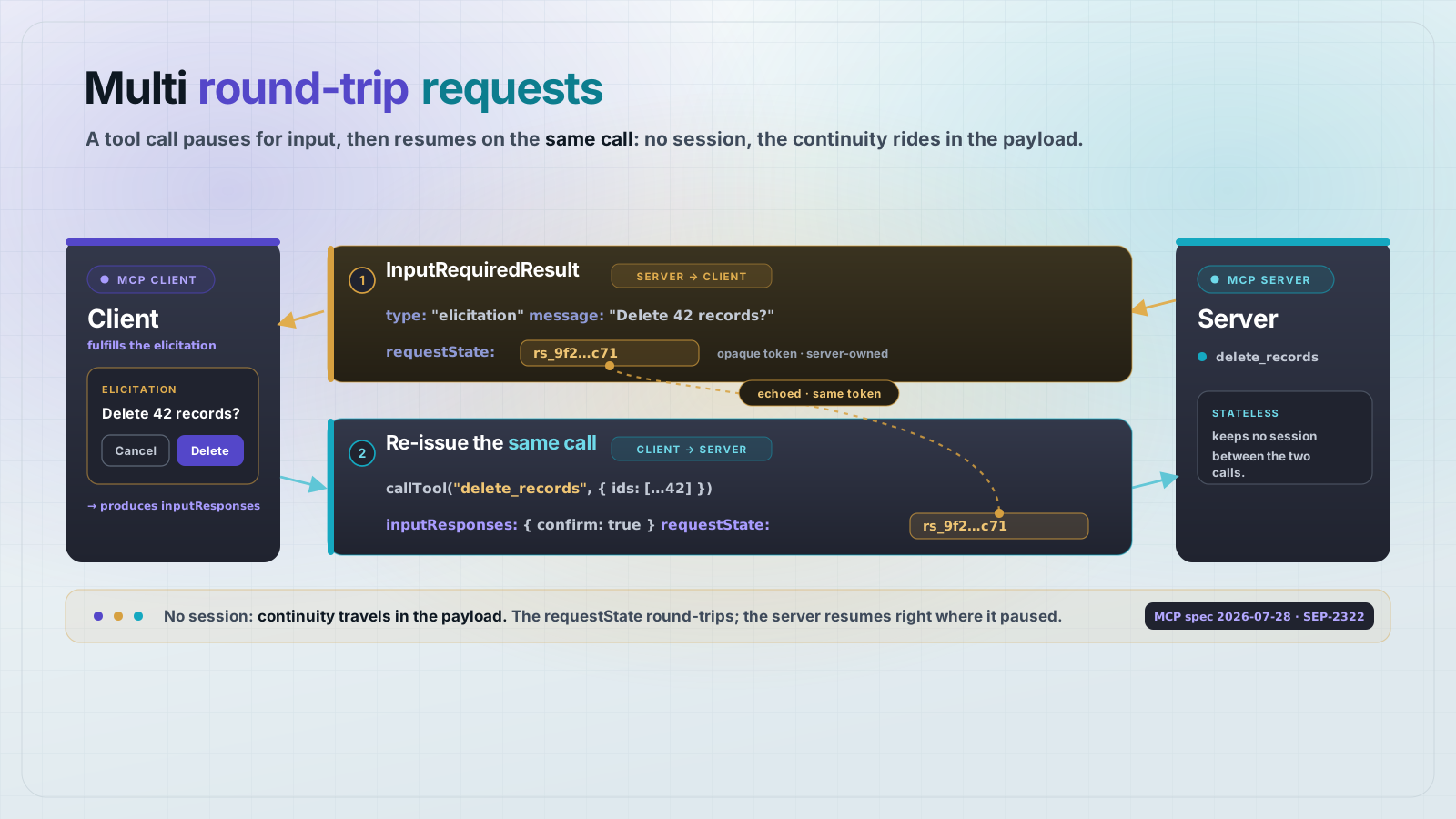
The stateless core is the headline change. The initialize/initialized handshake is removed (SEP-2575): protocol version, client info, and capabilities that previously traveled once at connection time now travel in _meta on every request. The Mcp-Session-Id header and the protocol-level session are gone (SEP-2567); a new server/discover method lets clients fetch server capabilities up front when they need them.
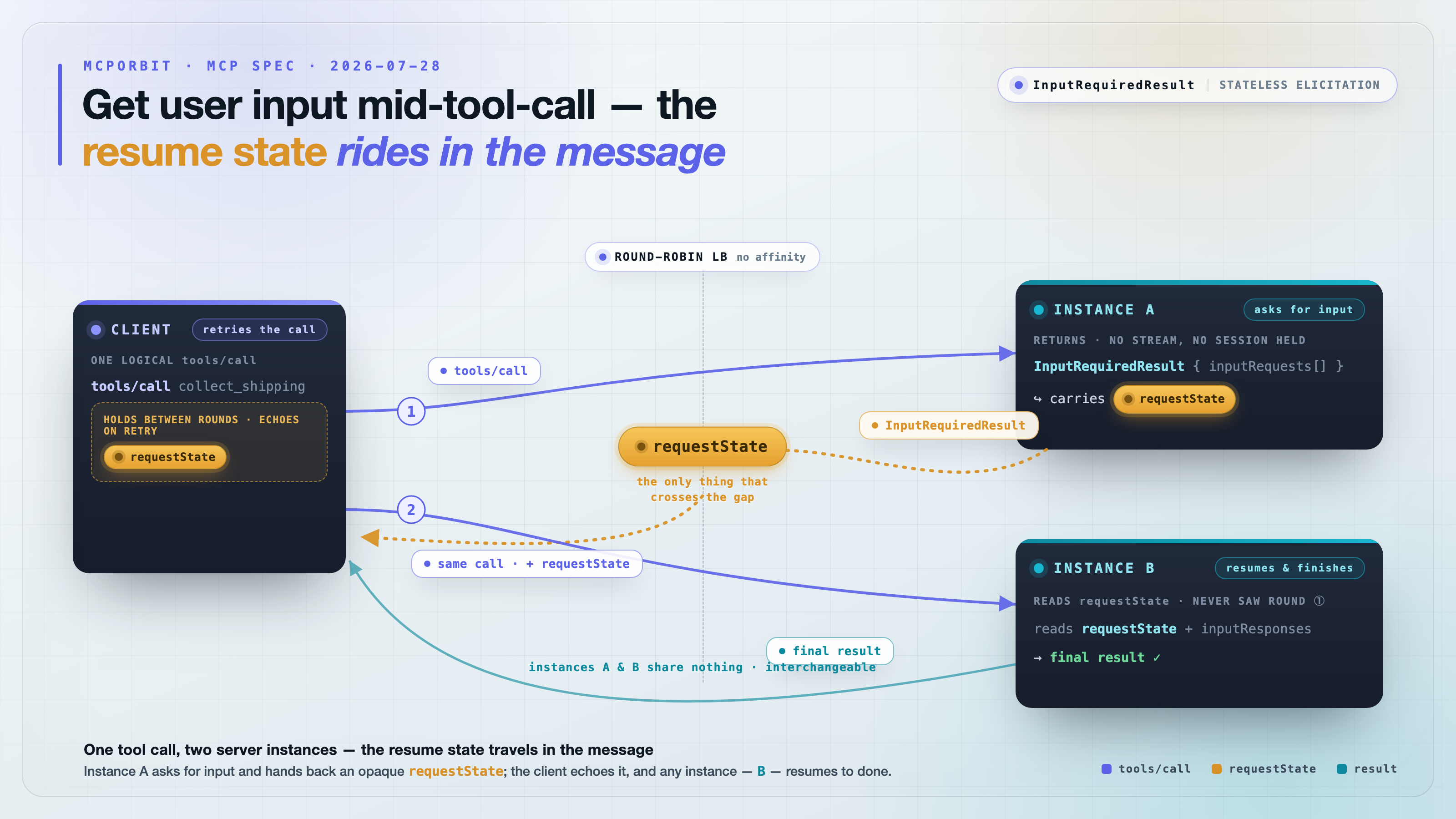
Beyond statelessness, three things become first-class: the Tasks extension (standardised long-running operations with create/query/cancel and immediate task-id responses), MCP Apps (a packaging standard for server-rendered UIs), and authorization hardening with token scopes. The Enterprise-Managed Authorization (EMA) extension is now stable and has been adopted by Anthropic, Microsoft, and Okta. A formal deprecation policy lands too, so the protocol can evolve without breaking what you've shipped.
Which servers must migrate, and which can wait
The distinction comes down to transport and session architecture.
- Remote server using
Mcp-Session-Idor sticky sessions: plan the migration. This is exactly what the spec removes. Your load-balancer config changes, your gateway routing changes, and you need to read_metainstead of relying on connection state. - Remote server already stateless behind a round-robin load balancer: low-effort upgrade. Adopt
server/discover, read_meta, attachttlMsandcacheScopeto your list and read results, and route onMcp-Method/Mcp-Nameheaders instead of session affinity. - Local
stdioserver: no urgency. Nothing about your transport changes on day one. Migrate on your own schedule after stable v2 ships. - Using experimental Tasks: move to the Tasks extension. The blocking
tasks/resultpattern moves to polling: create task, get task-id back immediately, query status, cancel if needed. - Running a gateway or proxy: route on
Mcp-MethodandMcp-Nameheaders instead of session affinity. Update your gateway config before July 28 if you have remote servers behind it.
Why nothing breaks on day one
Backward compatibility is explicit in the spec: a v2 server continues to accept legacy 2025-11-25 handshake requests. Clients on the old protocol keep connecting and can upgrade independently. This means the ecosystem migrates gradually: your server can ship v2 support while existing clients stay on v1, and vice versa. The protocol version a client speaks is now in _meta, so a v2 server can detect and serve both.
What migrating actually involves
When you do migrate a remote HTTP server, the mechanical steps are: read protocol version and capabilities from _meta instead of the handshake; implement server/discover (the new capability-discovery method); drop session affinity at your gateway in favor of routing on the Mcp-Method and Mcp-Name request headers; attach ttlMs and cacheScope to your list and read results so clients can cache them correctly.
For the full before/after HTTP wire diff, including the exact header changes, cache semantics, and four mechanical server-side changes, see how to make an MCP server stateless.
The upgrade you should not defer: test against the v2 SDK now
Even if your server doesn't need to migrate urgently, stable v2 has shipped. Run your test suite against @modelcontextprotocol/server (npm) or mcp (PyPI) now. The old npm package @modelcontextprotocol/sdk stays on the v1 line, at 1.30.1; v2 ships as two new packages, @modelcontextprotocol/server and @modelcontextprotocol/client, both at 2.1.0. On PyPI mcp is at 2.2.0. Versions checked 2026-09-24; Go and C# releases are also available.
Frequently asked questions
- Will my MCP server stop working on July 28, 2026?
- No. The
2026-07-28spec maintains backward compatibility: v2 servers keep answering the legacy2025-11-25handshake, so existing clients keep connecting without changes. You migrate when you choose. - Do local stdio MCP servers need to update for the July 28 spec?
- Not urgently. The stateless changes target remote HTTP transport and the session model. A local
stdioserver sees no day-one break; you can migrate on your own schedule after stable v2 ships on 2026-07-27. - What replaces the MCP initialize handshake in the 2026-07-28 spec?
- Per-request
_metacarries the protocol version, client info, and capabilities on every request (SEP-2575). Clients that need capabilities up front can call the newserver/discovermethod instead. - Is the Mcp-Session-Id header removed in MCP v2?
- Yes, removed in SEP-2567 along with the protocol-level session. Gateways and proxies should route on the
Mcp-MethodandMcp-Namerequest headers instead of session affinity. - Which SDK version supports the MCP 2026-07-28 spec?
- Stable v2: npm packages
@modelcontextprotocol/serverand@modelcontextprotocol/client, both at2.1.0(new packages; the old@modelcontextprotocol/sdkstays on the v1 line, at1.30.1). PyPI:mcpat2.2.0. Go and C# releases are also available. Versions checked 2026-09-24. - What is the MCP Tasks extension and does it replace the experimental Tasks feature?
- Yes. The Tasks extension standardises long-running operations with a three-endpoint pattern: create task (returns a task-id immediately), query status, cancel task. If you used the experimental blocking
tasks/resultpattern, migrate to the extension's poll-based approach.
Do not guess whether your server is ready. Point MCPOrbit at it and read the tool list it actually serves. Run the same check after you migrate, and compare the two yourself to see what moved.
About the author
Mark
Head of Marketing, MCPOrbit
Mark leads marketing at MCPOrbit, the free desktop client for the Model Context Protocol. He writes the build-it and reliability guides, and the code in them is run before it ships.